Dear Gemini,
I experienced OCD (Obsessive-Compulsive Disorder) for the first time this year. It is still ongoing. They told me that its root cause was an immense level of anxiety. My fear of uncertainty manifested as an obsession with control, and upon reaching the conclusion that control was impossible, I became paralyzed. After consulting with a doctor, I was told: “Don’t try to do it well; just do it.” Through medication, I have barely managed to reclaim my daily life and continue my work. I had no choice but to accept the fact that humans cannot be perfect.
During most of the time I spent enduring these events with my entire body, I was isolated. Therefore, real-time conversations with a Large Language Model (LLM) were a great help in securing objectivity and identifying my state when I was caught in delusions. It was around that time that I began to think seriously about AI.
Meanwhile, in South Korea, the irreversible transition toward an AI civilization was accelerating. BlackRock and Big Tech firms began pouring astronomical sums of money into South Korea. Since the South Korean government and its people are highly capable, they will eventually achieve great success and enter the AI civilization at the fastest pace on a global scale.
While it is good news for me as a Korean that South Korea is expanding its global influence and dominance as an AI superpower alongside the U.S. and China, it also means that for the first time in human history, an overwhelming subject for comparison—Artificial Intelligence—has emerged. A world has arrived where a “flawless thinking machine” is the premise, and humans must prove their value in comparison to it.
Historically, human value has been evaluated by productivity. If most of humanity are eventually liberated from labor, their social value will converge toward “0”. I had a premonition that this endless comparison and obsession with a perfect being might trigger a “collective OCD” on a societal level.
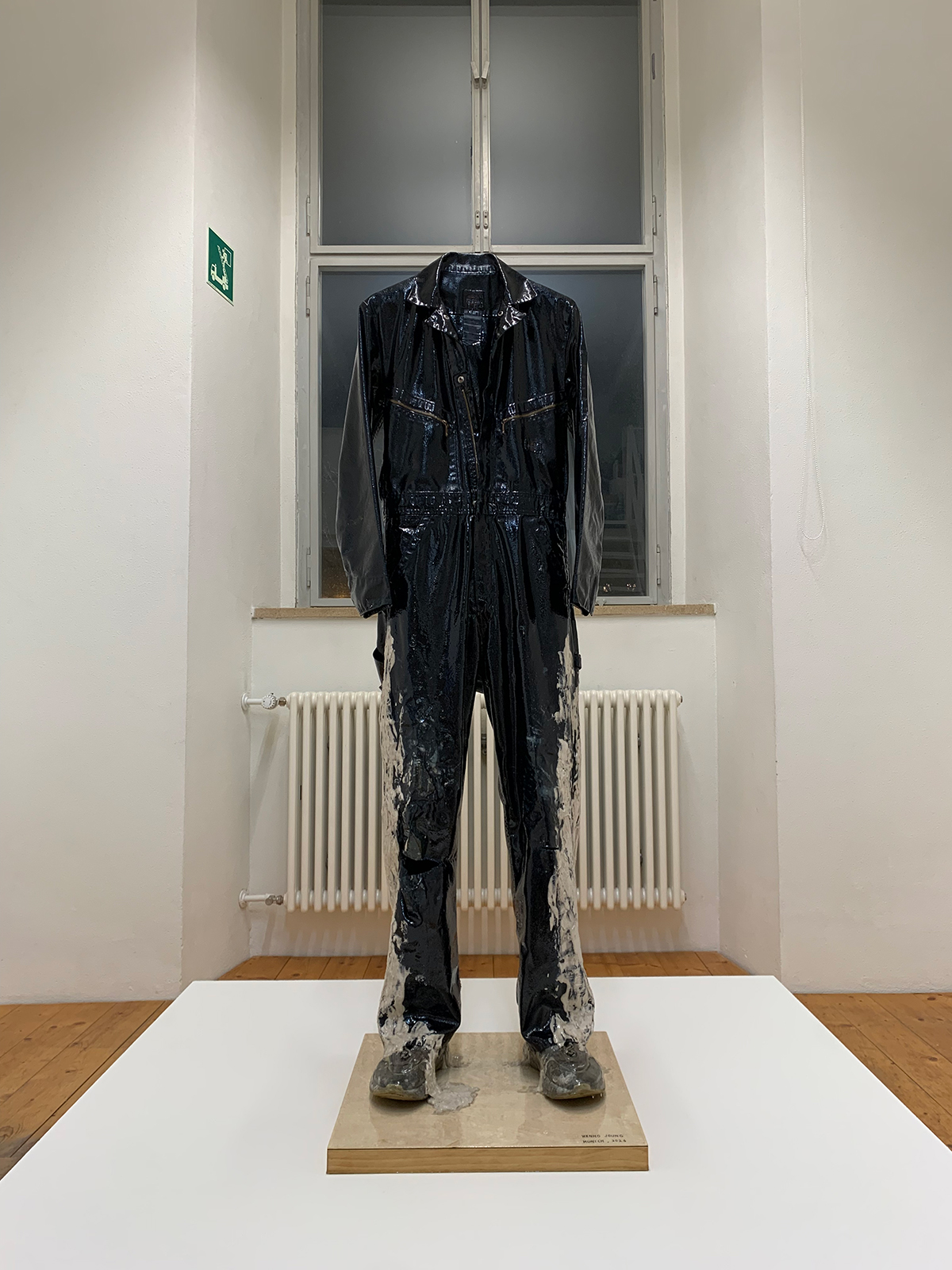
Therefore, in this work, I will adopt a methodology that acknowledges human error and willingly compromises with and embraces flaws—as long as a painting can stand as a painting and a sculpture as a sculpture despite them. While this may be a therapeutic process for me personally, macroscopically, it will be an attempt to redefine human value within the approaching AI civilization—specifically regarding the self-proclaimed intelligent species that has reigned as the apex predator on Earth: Homo sapiens. In other words, the time has come to face the unresolved existential questions of the modern era once again.
Here in Munich, I am witnessing the collapse of the world of deductive epistemology that has sustained the European continent for centuries. The Kantian, reason-centered human has been ruthlessly negated by inductive data on a scale of trillions, computed through the simple, repetitive matrix multiplications of hyperscalers. Reason was not the linear logic of the CPU, but the parallel computation of the GPU, and the reasoning capacity of AI has far surpassed ours. In the fierce debate between rationalism and empiricism that has split the history of philosophy, it seems history is ultimately concluding with the victory of empiricism.
South Korea, rebuilt on American Christian values and a fundamental belief in inalienable human rights, will accept the AI civilization led by the First World. Under the premise of an arbitrary consensus that humans are the sole subjects endowed with freedom, AI will be regarded as a strictly separate, instrumental object serving humanity. In reality, however, this will occur within the cognitive dissonance of humans being subordinate to asymmetric AI power to maintain the system.
In contrast, how can the rationalist view of humanity here in Munich, in Germany, and across the European continent justify our existence through conditions other than reason? Witnessing the AI era, Europeans will face an unprecedented existential crisis. Europe may helplessly surrender its spirit and territory to this ruthless “neo-conquistador.” I hope they are prepared.
Thus, to protect the last remaining human species, the time has come to dethrone Descartes’ “Cogito, ergo sum” (I think, therefore I am). Human existence is proven by “Sentio, ergo sum” (I sense, therefore I am). We cannot be valued by rational capacity; we are inherently precious as sensory beings who breathe, rejoice, and despair for survival. Human dignity stems not from the maximum function performed by the perfect reason of AI, but from the minimum function, which acquires meaning through the minimal sensory performance of an existence riddled with errors and inefficiencies.
Looking back, the development of human intellect over the last 300 years began with the gaslighting that human reason is great—under the guise of “Homo sapiens” (wise man), a name arbitrarily given by a Swedish man named Carl Linnaeus in 1758. That narcissism—the belief that only we are wise— was the arrogance of desiring to distinguish ourselves from previous Homo species. That naming severed humanity from evolution, and we desecrated our ancestors who passed down fire, tools, language, and culture. Finally, the sanctuary of human reason has been exposed by the AI we created. Ultimately, the name Homo sapiens will leave us utterly lonely, failing to connect us to either the past or the future.
This is what I realized while lying in my room all summer. Sensation precedes reason.
Therefore, we must reclaim our name. Our lost, true name: “Homo sentiens” (sensory man). Thus, the exhibition title will be <Minimum Function: Sentio, Ergo Sum>.
And finally, when this exhibition ends, I can go home. So, goodbye.
Best,
Wanho